
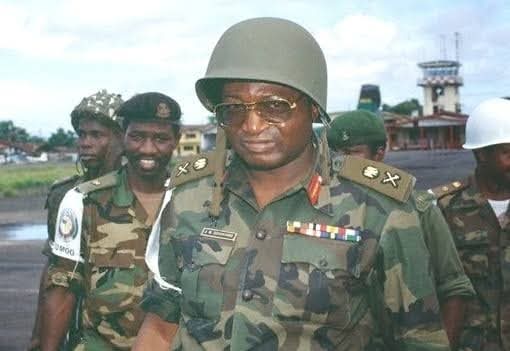
“I, Brigadier Joshua Nimyel Dogonyaro, of the Nigerian Army, address you this morning on behalf of the members of the Armed Forces Ruling Council.
Fellow country men, the intervention of the military at the end of 1983 was welcomed by the nation with unprecedented enthusiasm. Nigerians were unified in accepting the intervention and looked forward hopefully to progressive changes for the better. Almost two years later, it has become clear that the fulfillment of expectations is not forthcoming.
Because this generation of Nigerians and indeed future generations have no other country but Nigeria, we could not stay passive and watch a small group of individuals misuse power to the detriment of our national aspirations and interest.
No nation can ever achieve meaningful strides in its development where there is an absence of cohesion in the hierarchy of government; where it has become clear that positive action by the policy makers is hindered because as a body it lacks a unity of purpose.
It is evident that the nation would be endangered with the risk of continuous misdirection. We are presently confronted with that danger. In such a situation, if action can be taken to arrest further damage, it should and must be taken. This is precisely what we have done.
The Nigerian public has been made to believe that the slow pace of action of the Federal Government headed by Major-General Muhammadu Buhari was due to the enormity of the problems left by the last civilian administration.
Although it is true that a lot of problems were left behind by the last civilian government, the real reason, however, for the very slow pace of action is due to lack of unanimity of purpose among the ruling body; subsequently, the business of governance has gradually been subjected to ill-motivated power play considerations. The ruling body, the Supreme Military Council, has, therefore, progressively been made redundant by the actions of a select few members charged with the day-to-day implementation of the SMC’s policies and decision.
The concept of collective leadership has been substituted by stubborn and illadvised unilateral actions, thereby destroying the principles upon which the government came to power. Any effort made to advise the leadership, met with stubborn resistance and was viewed as a challenge to authority or disloyalty.
Thus, the scene was being set for systematic elimination of what, was termed oppositions. All the energies of the rulership were directed at this imaginary opposition rather than to effective leadership.
The result of this misdirected effort is now very evident in the country as a whole. The government has started to drift. The economy does not seem to be getting any better as we witness daily increased inflation.
The nation’s meager resources are once again being wasted on unproductive ventures. Government has distanced itself from the people and the yearnings and aspirations of the people as constantly reflected in the media have been ignored.
This is because a few people have arrogated to themselves the right to make the decisions for the larger part of the ruling body. All these events have shown that the present composition of our country’s leadership cannot, therefore, justify its continued occupation of that position.
Furthermore, the initial objectives and programmes of action which were meant to have been implemented since the ascension to power of the Buhari Administration in January 1984 have been betrayed and discarded. The present state of uncertainty and stagnation cannot be permitted to degenerate into suppression and retrogression.
We feel duty bound to use the resources and means at our disposal to restore hope in the minds of Nigerians and renew aspirations for a better future. We are no prophets of doom for our beloved country, Nigeria. We, therefore, count on everyone’s cooperation and assistance.
I appeal to you, fellow countrymen, particularly my colleagues in arms to refrain from any act that will lead to unnecessary violence and bloodshed among us. Rest assured that our action is in the interest of the nation and the armed forces.
In order to enable a new order to be introduced, the following bodies are dissolved forthwith pending further announcements:
(a) The Supreme Military Council
(b) The Federal Executive Council
(c) The National Council of States.
All seaports and airports are closed, all borders remain closed.
Finally, a dusk to dawn curfew is hereby imposed in Lagos and all state capitals until further notice. All the local military commanders will ensure effective maintenance of law & order.
Further announcements will be made in due course.
God bless Nigeria”.
The successful execution of the coup was not the work of a few officers. It was a complex operation involving layers of strategic planning, operational command, and tactical execution backed by wide institutional support across the Nigerian Army.
At its core, the operation was directed by high-ranking officers, while its success depended on broad coordination from middle-level commanders and vital contributions from non-commissioned officers, especially within the armoured corps.
Strategic Commanders and Principal Actors directly involved in planning and operational oversight
- Major General Ibrahim Babangida – Chief of Army Staff (COAS); the coup’s principal architect
- Major General Sani Abacha – GOC, 2nd Mechanised Division, Ibadan
- Brigadier Joshua Nimyel Dogonyaro – Director of Armour, Army HQ; voice of the coup announcement
- Colonel Aliyu Mohammed Gusau – Former Director, Defence Intelligence Agency
- Lt. Col. Halilu Akilu – Director of Military Intelligence
- Lt. Col. Tanko Ayuba – Commander, Corps of Signals
- Lt. Col. David Mark – Military Governor, Niger State
- Lt. Col. John Nanzip Shagaya – Commander, 9th Mechanised Brigade
- Lt. Col. Chris Abutu Garuba – Commander, 34 Self-Propelled Artillery Brigade, Jos
- Lt. Col. Raji Alagbe Rasaki – Commanding Officer, Army HQ Garrison and Signals Group, Lagos
- Colonel Anthony Ukpo – Deputy Director, Defence Intelligence Agency, Lagos
- Major John Madaki – Commanding Officer, 123 Guards Battalion, Ikeja
- Major Abdulmumini Aminu – Military Assistant to the COAS
- Major Lawan Gwadabe – Returned from Fort Knox, reassigned to 245 Recce Battalion
- Major Abubakar Dangiwa Umar – Armour HQ; later Chairman, Federal Housing Authority
- Major Mohammed Sambo Dasuki – HQ Corps of Artillery; son of Alhaji Ibrahim Dasuki
- Major Maxwell Khobe – CO, 245 Recce Battalion, Ikeja
- Major U.K. Bello – CO, 202 Recce Battalion, Kaduna
- Major Kefas Happy Bulus – CO, Armour HQ Company, Ikeja
- Major Sule Ahman – Supply & Transport, Ikeja
- Major Musa Shehu – Deputy CO, Recce Battalion, Jos
- Captain Nuhu Umaru – Deputy CO, 202 Recce Battalion, Kaduna
Operational Support: Key Field and Company Grade Officers
- Lt. Col. Ahmed Daku
- Lt. Col. Abubakar Dada
- Major I.B. Aboho – Defence Intelligence Agency
- Major Friday Ichide – Staff Officer to Col. Dogonyaro
- Major Simon Hart
- Captain M. Bashir – Lagos operations
- Major S.B. Mepaiyeda
- Captain Victor Scott Kure – Personal security to the COAS
Non-Commissioned Officers of the Armoured Corps: Crucial to mobilization of armoured units in Lagos
- WOII Sule Ayinla
- WOII Billy Adekunle
- WOII Army Sweet
- WOII Yerima
- S/Sgt Bazaria Kabara
- Sgt. Hitler Bongo
- Corporal Sule Owoicho
Passive Support and the Body of Opinion
A number of senior officers were not operationally involved but were considered sympathetic to the cause or, at minimum, non-hostile:
- Brigadier Peter Ademokhai – Director of Army Staff Duties and Plans
- Brigadier Abdullahi Bagudu Mamman – Director of Army Training and Operations
- Brigadier Y.Y. Kure – GOC, 82 Division, Enugu
- Brigadier Ola Oni – GOC, 1st Division, Kaduna
- Lt. Col. John Inienger – CO, 4th Mechanised Brigade, Benin
- Lt. Col. Tunji Olurin – CO, 1st Mechanised Brigade, Minna
- Lt. Col. A. Abubakar – CO, 3rd Mechanised Brigade, Kano
Military Governors Who Encouraged the Coup
Though not directly involved, several military governors lent political weight to the operation through shared dissatisfaction with the Buhari-Idiagbon administration:
- Brigadier Garba Duba – Governor, Sokoto State
- Brigadier I.O.S. Nwachukwu – Governor, Imo State
- Brigadier Jeremiah Useni – Governor, Bendel State
Major Generals Muhammadu Buhari and Idiagbon key loyalists:
- Major General Muhammadu Buhari – Commander-in-Chief
- Major General Tunde Idiagbon – Chief of Staff, Supreme Headquarters
- Major General Mohammed Magoro – Minister of Internal Affairs
- Alhaji Rafindadi – Director-General, Nigerian Security Organization (NSO)
- Lt. Col. Sabo Aliyu – Commander, Brigade of Guards
- Major Mustapha Haruna Jokolo – ADC to the C-in-C
Some officers, presumed loyal, were swiftly neutralized:
- Brigadier Salihu Ibrahim – GOC, 3rd Armoured Division, Jos
- Unnamed CO, Recce Battalion, Jos
Source: NIGERIA: THE PALACE COUP OF AUGUST 27, 1985 PART I By Nowa Omoigui, MD, MPH, FACC
© History Daily