










By Amb Miri Timnan Nyantau (M.T.N)
A comprehensive analysis of the ruling All Progressives Congress (APC) registered membership data in Plateau State, set against the newly enacted Electoral Act 2026, reveals a dynamic and competitive internal election statistics that closely mirrors broader electoral realities across the state’s federal constituencies and senatorial districts.
Under the 2026 Electoral Act signed into law by President Bola Tinubu, political parties hoping to field in candidates for the 2027 general elections will conduct direct primaries, a system that empowers all registered members as delegates to vote directly for party candidates. This abolishes the old indirect delegate system, expanding participation and elevating grassroots influence in candidate selection.
Senatorial District Overview: A Three – Way Balance
When broken down by senatorial districts, the race appears remarkably close:
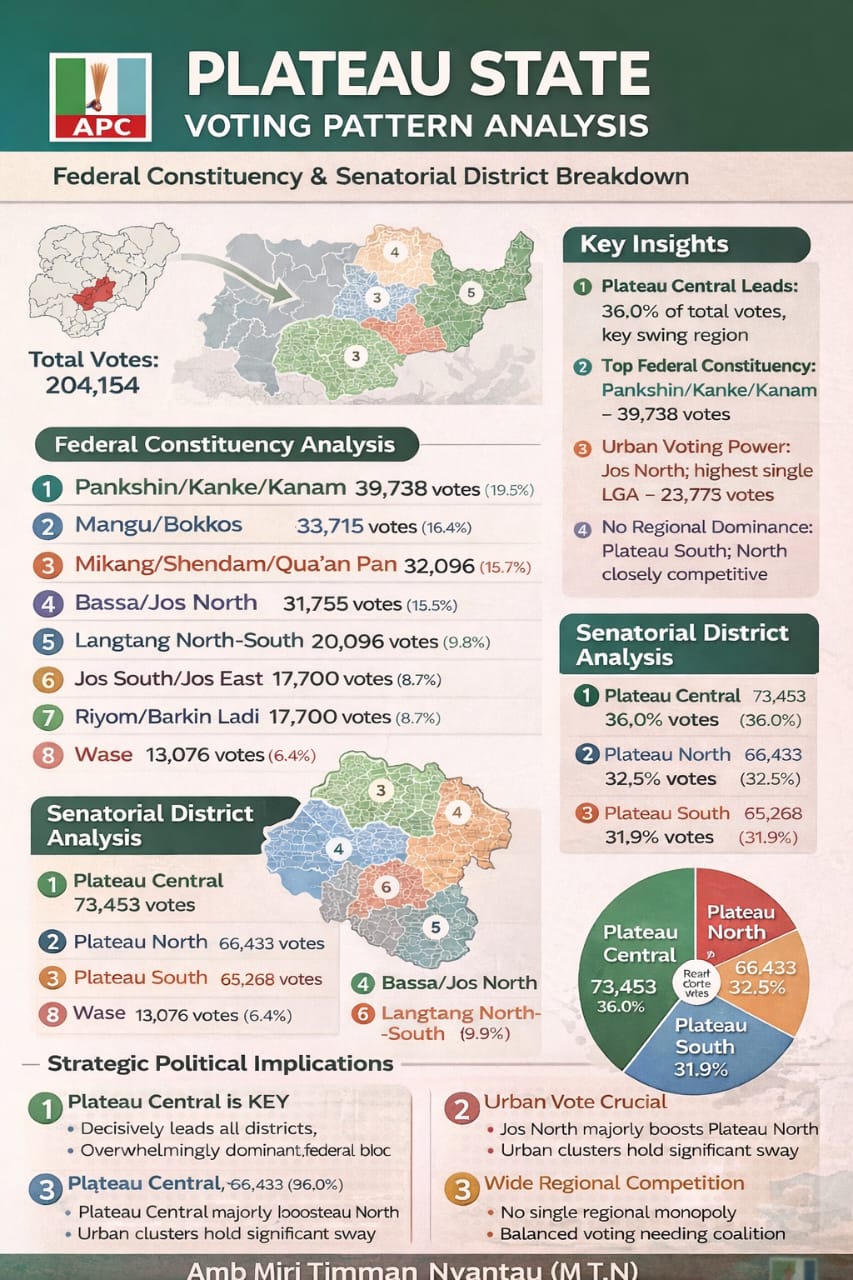
Plateau Central – 73,453 votes (36.0%)
Plateau North – 66,433 votes (32.5%)
Plateau South – 65,268 votes (31.9%)
Plateau Central leads, but not overwhelmingly. The margin between Plateau North and Plateau South is extremely slim. What this means politically is simple: no region can win alone the gubernatorial primaries. Alliances and turnout efficiency matter.
Plateau Central, however, stands out as the state’s electoral anchor. Any serious statewide strategy must begin there.
Federal Constituency Breakdown: Where the Real Power Lies
Looking deeper into the federal constituencies gives a clearer picture of where influence truly sits.
a) Bassa/Jos North Federal Constituency
(Jos North + Bassa)
23,775 + 7,980 = 31,755 votes
Percentage: 15.5%
b) Jos South/Jos East Federal Constituency
(Jos South + Jos East)
12,828 + 4,872 = 17,700 votes
Percentage: 8.7%
c) Riyom/Barkin Ladi Federal Constituency
(Riyom + Barkin Ladi)
7,883 + 9,095 = 16,978 votes
Percentage: 8.3%
d) Mangu/Bokkos Federal Constituency
(Mangu + Bokkos)
22,782 + 10,933 = 33,715 votes
Percentage: 16.4%
e) Pankshin/Kanke/Kanam Federal Constituency
(Pankshin + Kanke + Kanam)
11,954 + 9,713 + 18,071 = 39,738 votes
Percentage: 19.5%
f) Wase Federal Constituency
(Wase only)
13,076 votes
Percentage: 6.4%
g) Langtang North & South Federal Constituency
(Langtang North + Langtang South)
10,307 + 9,789 = 20,096 votes
Percentage: 9.8%
h) Mikang/Shendam/Qua’an Pan Federal Constituency
(Mikang + Shendam + Qua’an Pan)
5,213 + 16,252 + 10,631 = 32,096 votes
Percentage: 15.7%
Statistical Interpretation:
- Pankshin/Kanke/Kanam – 39,738 votes (19.5%)
This is the single largest federal bloc in the state. Nearly one in every five votes comes from here. It is not just important, it is decisive. A strong showing in this constituency significantly shifts statewide arithmetic.
2. Mangu/Bokkos – 33,715 votes (16.4%)
Driven heavily by Mangu’s performance, this constituency forms another powerful pillar within Plateau Central. Together with Pankshin/Kanke/Kanam, it explains why Plateau Central leads overall.
3. Mikang/Shendam/Qua’an Pan – 32,096 votes (15.7%)
This southern bloc proves that Plateau South is far from weak. Shendam’s numbers in particular make this constituency a serious political force.
4. Bassa/Jos North – 31,755 votes (15.5%)
This is the state’s most urban-influenced constituency. Jos North alone produces 23,775 votes, the highest single LGA total statewide. Urban concentration here plays a major role in keeping Plateau North competitive.
Mid-Level Constituencies
Langtang North/South – 20,096 votes (9.8%)
Jos South/Jos East – 17,700 votes (8.7%)
Riyom/Barkin Ladi – 16,978 votes (8.3%)
Wase (stand-alone) – 13,076 votes (6.4%)
Wase, despite standing alone, remains strategically relevant because of its compact and mobilizable voter base.
The Senatorial Contests: “Kato Bayan Kato”
With direct primaries empowering registered members, contests are expected to be intense.
Plateau South Senatorial Zone
AVM (Rtd) Napoleon Binkap Bali
Senator Simon Bako Lalong
Dr. Nanzing Nden
Alphonsus Komsol
With 65,268 registered members (31.9%), Plateau South is nearly equal to Plateau North in strength. Statistically, any candidate who consolidates 50%+1 here could emerge highly competitive statewide.
Plateau Central Senatorial Zone
Senator Diket Plang
Hon. Ephraim Usman Gar
Plateau Central’s 73,453 members make this the most strategically important zone. Winning convincingly here creates a structural advantage difficult to overcome.
Plateau North Senatorial Zone
Senator Simon Mwadkwon
Senator I.D. Gyang
Dr Chris Giwa
Hon Musa Dachung Bagos
With 66,433 members, Plateau North’s outcome will likely hinge on urban turnout, especially in Jos North.
What the Numbers really mean?
1. No Senatorial Monopoly
The narrow margins between districts confirm a competitive three-way balance.
2. Plateau Central Is the Statistical Kingmaker
Holding 36% of all registered APC members, Central is the decisive zone.
3. Urban Influence Is Significant
Jos North alone represents over 11% of total membership, a powerful urban voting bloc.
4. Turnout Will Matter More Than Registration
Because margins between districts are small, differences in turnout rates, even 3 – 5%, could change outcomes.
Final Analysis
The APC’s move to direct primaries under the Electoral Act 2026 has fundamentally shifted internal power dynamics in Plateau State. Instead of a limited delegate class, over 204,000 registered members will determine candidates.
Statistically, Plateau Central enters the race with an edge. Politically, however, the near-equal distribution across the three senatorial districts means coalition-building and strategic mobilization will be decisive.
The race ahead is not defined by dominance, it is defined by margins. And in Plateau State, margins decide everything