








Nigeria’s football has entered another familiar season, the season of change at the Glass House.
Ibrahim Musa Gusau is leaving. A Normalisation Committee is being discussed. Musa Amadu’s name is circulating within football circles. Beyond whatever temporary arrangement emerges, another familiar figure, Barrister Seyi Akinwunmi, is increasingly being mentioned in conversations about the future.
But Nigerian football has been here before.
Presidents change. Board members change. Coaches come and go. Committees are constituted and dissolved. Yet many of the problems survive every administration.
That is why Gusau’s departure should not automatically be celebrated as the beginning of a new era. It should instead force Nigerian football to confront a more difficult question: is the problem really the person occupying the NFF presidency, or the system that produces and sustains him?
Gusau came into office in 2022 with a strong mandate. In the first ballot, he secured 21 votes against Seyi Akinwunmi’s 12 and Shehu Dikko’s six. After the rerun, he emerged overwhelmingly with 39 votes.
Four years later, the mood could hardly be more different.
Results on the pitch became increasingly difficult to defend. The Super Eagles failed to qualify for the 2026 FIFA World Cup, making it consecutive absences from football’s biggest stage. The Super Falcons also failed to reach the 2027 FIFA Women’s World Cup, an outcome that would once have been almost unthinkable for Nigeria.
The age grade teams did little to calm the situation. Qualification failures across different levels strengthened the feeling that Nigeria was no longer merely losing matches. It was gradually losing the structure that once made qualification appear almost automatic.
Then attention shifted from the pitch to administration.
The EFCC and ICPC began investigating the utilisation of Federal Government intervention funds released for national team obligations. Investigation does not amount to guilt, and allegations must not be treated as convictions. But when poor results, public distrust and questions about financial management arrive at the same time, leadership becomes difficult to sustain.
The entire board eventually stepped aside only weeks before an anticipated reelection battle that already appeared to be gathering its own political momentum.
Now comes the uncertainty.
Unconfirmed reports suggest that Musa Amadu, former NFF General Secretary, could head a Normalisation Committee to oversee Nigerian football pending the election of a substantive board.
There is an interesting irony in that possibility.
Normalisation Committees became familiar in Nigerian football when similar arrangements were imposed in some State Football Associations, sometimes displacing sitting chairmen and changing established power structures. The instrument once used to reorganise others could now become the vehicle for reorganising the federation itself.
But the real question is not who chairs such a committee.
The real question is what happens after it.
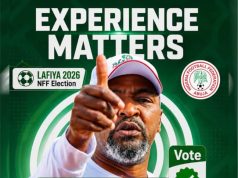
This is where Seyi Akinwunmi enters the conversation.
Akinwunmi is no stranger to the Glass House. He served for eight years as NFF First Vice President, led the Lagos State Football Association for many years and has long been associated with grassroots football development. He also contested against Gusau in 2022 before withdrawing ahead of the decisive rerun.
Four years later, Nigerian football may have travelled a remarkable circle.
The man who defeated him is leaving, while the position he once sought could again become available.
There is also a political dimension that cannot simply be ignored. Football administration in Nigeria has never existed completely outside the country’s wider political environment. Regional blocs, State FA chairmen, Congress delegates, government relationships and personal alliances have always mattered.
The belief in some football circles that Akinwunmi may enjoy support from powerful interests therefore deserves attention, although it remains speculation until clear evidence emerges.
The Yoruba dimension has also entered the discussion. No Yoruba administrator has historically occupied the NFF presidency in the modern era, and with President Bola Tinubu in power, some already see Akinwunmi’s possible emergence through that political lens.
But reducing Nigerian football to ethnicity would miss the larger problem.
Even if Akinwunmi eventually becomes president, his greatest challenge will not be winning the election. It will be proving that another change of leadership can finally produce a change of system.
Nigeria’s football crisis did not begin with Musa Gusau, and it will not disappear because he has resigned.
The problems run from the national teams to grassroots football, coaching development, refereeing, youth competitions, club administration, infrastructure, sponsorship, financial accountability and the often complicated relationship between government and the federation.
Nigeria has never lacked football talent.
What Nigeria repeatedly lacks is a football system capable of discovering, developing and sustaining that talent.
For too long, the country has depended on individual brilliance to cover institutional weakness. We wait for another Okocha, another Kanu, another Osimhen or another Asisat Oshoala.
Serious football nations do not simply wait for exceptional players to appear.
They build structures that continually produce them.
Nigeria’s population should be an advantage, not a development strategy.
If Musa Amadu eventually heads a Normalisation Committee, his assignment should therefore go beyond preparing elections. It should help restore confidence, interrogate persistent administrative failures and create conditions for genuine reform.
And if Seyi Akinwunmi eventually emerges as president, his previous experience inside the system will become both an advantage and a burden.
He cannot completely present himself as an outsider coming to rescue an institution he once helped to lead. His years as NFF First Vice President give him knowledge of the system, but they also give Nigerians the right to ask what he would now do differently.
The country needs functioning youth competitions, credible pathways from academies and schools into professional football, stronger coaching development, transparent finances, better leagues and national teams whose qualification campaigns are built on planning rather than late permutations.
For now, Gusau is leaving the stage.
Musa Amadu may or may not become the bridge.
Seyi Akinwunmi may or may not eventually cross that bridge into the presidency.
But the days ahead will place the Glass House firmly under the spotlight.
There will be meetings, alliances and realignments. State FA chairmen will calculate where the next centre of power may emerge. Some will reposition themselves. Others may discover that the political ground beneath them has shifted.
That is Nigerian football politics.
But when all the manoeuvring is over, one stubborn truth will remain.
Changing the occupants of the Glass House is easy.
Changing the system inside it is the real match.
And that is the match the next leadership of Nigerian football cannot afford to lose