










By Amb. Miri Timnan Nyantau (M.T.N)
Politics, at its highest altitude, is neither driven by emotion nor sustained by nostalgia. It is governed by structure, strategic alignment, and the cold logic of survival, both of institutions and of the people they are meant to serve.
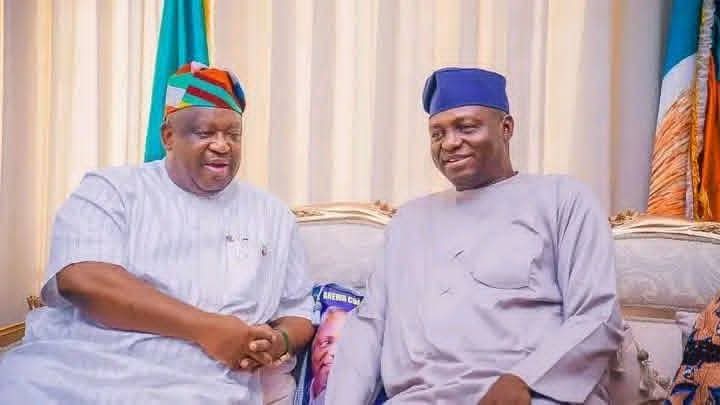
Leaders who misunderstand this reality often mistake loyalty to a collapsing platform for principle, when in fact it is recklessness disguised as virtue. It is within this sober framework that Governor Caleb Manasseh Mutfwang’s decision to align with the All Progressives Congress (APC) on Friday, 2nd January 2026, must be situated.
The Peoples Democratic Party (PDP), Governor Mutfwang’s former political home, has long ceased to function as a coherent political institution. Today, it exists more in court registries than in town halls.
The party is deeply factionalized and ideologically hollowed out, with rival claims to leadership between the faction led by former Minister of Special Duties under President Goodluck Jonathan, Barrister Kabiru Turaki, and the opposing bloc under Abdulrahman.
What should have been an arena for internal democracy degenerated into perpetual litigation, eroding authority, discipline, and organizational legitimacy.
Political scientist Giovanni Sartori warned that parties collapse not when they lose elections, but when they lose internal cohesion and institutional purpose.
The last general election was a brutal validation of this thesis. The PDP’s inability to present a united structure led to catastrophic consequences: all State and Federal legislative seats were lost to the APC, not necessarily through popular rejection, but through judicial disqualification and organizational failure. A party without structure cannot protect mandates; a party without unity cannot project power.
Governor Mutfwang himself narrowly escaped this institutional disaster. His victory survived by a whisker at the Supreme Court, an experience that should sober any serious leader. Governance cannot be anchored on judicial luck.
As Samuel Huntington observed, “Political decay occurs when institutions fail to adapt to changing circumstances.” The PDP did not merely fail to adapt; it imploded.
Yet beyond party collapse lies a deeper and more consequential dimension of this realignment: the imperative of strategic alignment with the Federal Government led by President Bola Ahmed Tinubu.
In a federal system such as Nigeria’s, subnational leadership that isolates itself from the centre does so at great cost to its people. Politics may permit opposition, but governance, especially in fragile regions, demands collaboration.
Plateau State is too strategic in Nigeria’s political and security architecture to be governed in deliberate isolation. Sitting at the crossroads of the Middle Belt, Plateau is not merely a geographic entity; it is a national fault line where identity, security, and state capacity intersect.
For decades, Plateau communities have suffered unspeakable violence, men, women, and children murdered in their sleep, villages wiped out, lives shattered while politics debated semantics. These are not abstract statistics; they are human tragedies demanding coordinated state response.
Max Weber defined the state as the entity that successfully claims the monopoly of legitimate use of force. When insecurity persists, it is often because authority is fragmented and coordination weak.
A governor operating from an opposition enclave, cut off from the commanding heights of federal security architecture, operates at a severe disadvantage. Intelligence sharing, military responsiveness, and emergency interventions are not strengthened by political distance from Abuja.
Governor Mutfwang’s alignment with the APC therefore transcends party arithmetic; it is a strategic recalibration aimed at safeguarding lives. It signals a recognition that security, development, and stability are not achieved through symbolic defiance, but through institutional cooperation.
President Bola Ahmed Tinubu’s administration controls the levers of national power, security agencies, fiscal instruments, and intergovernmental coordination mechanisms. Plateau State cannot afford to be peripheral to these dynamics.
Niccolò Machiavelli cautioned that leaders who ignore power realities invite ruin, not martyrdom. To remain within a disintegrating PDP while Plateau bleeds would have been politically romantic but morally indefensible.
Leadership, at critical moments, requires the courage to abandon collapsing structures in favour of viable ones that can deliver concrete outcomes.
Governor Mutfwang’s realignment is therefore best understood as an act of political responsibility. It shows clearly an understanding that governance requires more than electoral victory, it requires a stable platform, institutional backing, and alignment with national power centres. A party trapped in endless litigation cannot govern; a state isolated from the federal centre cannot secure its people.
In repositioning with the APC, Governor Mutfwang has chosen pragmatism over sentiment, structure over symbolism, and collaboration over isolation. History judges leaders not by the parties they served, but by the lives they protected and the stability they delivered. In moments of institutional collapse, serious leaders do not cling to ruins, they reposition to preserve the future.
M.T.N is the National President of Tarok Progressive Youth Association, (TAPYA) the umbrella body of Tarok Youth Worldwide & President General, Middle Belt Ethnic Youth Leaders Assembly (MBEYLA)